
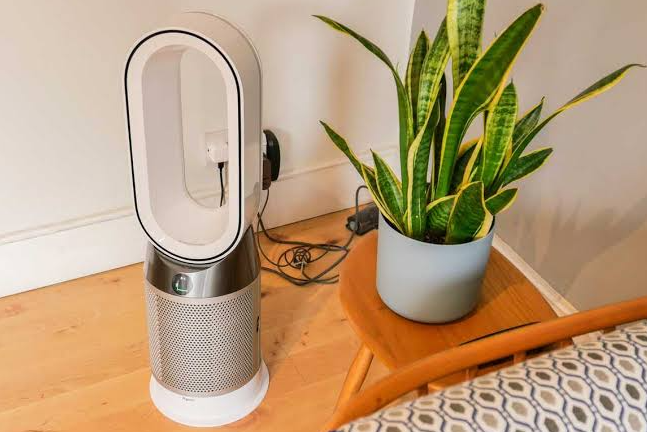
When you drop $400-plus on an air purifier, you expect it to do one thing exceptionally well: clean your air. Dyson’s Pure Cool promises that, wrapped in a bladeless tower that also doubles as a fan. It’s sleek. It’s futuristic. It’s all over Instagram.
But strip away the design language and ask a simpler question — how much clean air does this thing actually move? — and the picture gets a lot less flattering.
I bought one, tested it, and dug through the spec sheets Dyson doesn’t put front and center on their US site. Here’s what I found.
Read More: Best Air Purifier to Remove Smoke
The Quick Verdict
Dyson Pure Cool sells you an experience: a quiet tower, a companion app, oscillation, and a fan you can run through summer. It does not sell you class-leading air cleaning per dollar. If purification is your primary goal, you’re paying a design premium for middling throughput.
What the Pure Cool Actually Is
Strip the marketing away and an air purifier is a fan pulling air through a filter. That’s it. The Pure Cool wraps that simple mechanism in a bladeless tower, a HEPA H13 filter, an activated carbon layer, and a Dyson Link app that reports air quality and lets you schedule modes from your phone.
It’s genuinely well-built. The fan is quiet on low settings, the oscillation is smooth, and the app interface is one of the nicer ones in the category. None of that is in dispute.
Where It Falls Short
Clean Air Delivery Rate (CADR) is the industry-standard measure of how much filtered air a purifier actually pushes into a room per hour. It’s not a perfect test — it’s run in a lab, not your living room — but it’s the closest thing the industry has to an apples-to-apples comparison.
Dyson doesn’t advertise CADR numbers prominently in the US. You have to go looking, and the number that turns up for the TP05 is unremarkable: around 164 m³/hr for particulates. For context, that’s in the range of purifiers costing a fraction of the price, some of them simple DIY box-fan builds.
| What CADR measures | Why it matters |
|---|---|
| Particulate range (dust, pollen, smoke) | Tells you how fast the whole room actually clears, not just how good the filter media is |
| Airflow through the filter | A great filter paired with a weak fan still moves air slowly |
| Comparable across brands | Lets you shop on performance, not marketing copy |
Nerd Note: CADR and filter efficiency are two different numbers. A HEPA H13 filter can catch 99.95% of particles that pass through it on a single pass — that’s the EN1822 rating. But if the fan behind it is weak, the room still clears slowly. Dyson’s HEPA rating is genuinely good. Its airflow is the bottleneck.
The Company’s Response
To Dyson’s credit, when pressed on this, they didn’t dodge the question. Their position is that they don’t engineer for CADR at all — they design around their own internal real-world testing instead, arguing lab tests like CADR don’t reflect how purifiers behave in an actual home.
There’s a real point buried in there. Lab CADR tests do use sealed test chambers that don’t match a living room with doors, drafts, and furniture. Real-world testing is a legitimate and useful complement. But “we don’t test for the industry standard” is a different claim than “the industry standard is meaningless” — and a purifier that’s weak in a controlled lab test isn’t obviously going to out-clean the competition once you add real-world variables back in.
Design and Livability
This is genuinely where the Pure Cool earns its price tag:
- Quiet operation. On low-to-mid fan speeds it’s close to silent, which matters if it’s running in a bedroom overnight.
- Dual function. It cools as a fan in summer and doubles as a purifier year-round — one appliance, one footprint.
- App and automation. Scheduling, air quality history, and auto mode that reacts to a built-in sensor are all polished.
- Furniture-grade design. It doesn’t look like a medical device sitting in your living room, which, for a lot of buyers, is worth something.
None of that shows up in a CADR number, and none of it is fake value. It’s just a different kind of value than “cleans your air fast.”
Price vs. Performance
Here’s the tension in one line: you’re paying flagship pricing for mid-pack particulate removal. A budget purifier a third of the price can move comparable or better volumes of clean air; it just won’t oscillate, connect to an app, or look good next to your sofa.
| Priority | Better fit |
|---|---|
| Fastest possible room air turnover per dollar | A dedicated HEPA purifier with a published, competitive CADR |
| Quiet, good-looking multi-season appliance with smart features | Dyson Pure Cool |
| Tightest budget, purification is the only goal | A basic HEPA + fan combo, DIY or budget-branded |
So, Is It Worth It?
If you’re buying a Pure Cool as an air purifier first, it’s hard to recommend on the numbers alone — you can get faster room clearance for meaningfully less money. If you’re buying it as a year-round fan and app-connected air-quality monitor that also filters the air reasonably well, and you value the design and the quiet operation, it’s a more defensible purchase. Just go in knowing which one you’re paying for.
FAQ
Does the Dyson Pure Cool actually remove allergens and dust? Yes — the HEPA H13 filter genuinely captures fine particles at a high rate on each pass. The open question isn’t filter quality, it’s how quickly the fan cycles enough room air through that filter to matter.
Is a cheaper purifier really as good? For raw particulate CADR, several budget purifiers post comparable or higher numbers. What they typically lack is the design, app integration, dual fan/purifier function, and quiet-running engineering Dyson invests in.
Should I trust Dyson’s own internal test over CADR? Treat it as a second data point, not a replacement. Real-world testing has value, but a company’s own internal methodology — especially one it doesn’t fully publish in English — isn’t a substitute for an independently comparable, published standard.